
The Evolution of ZetaView® NTA
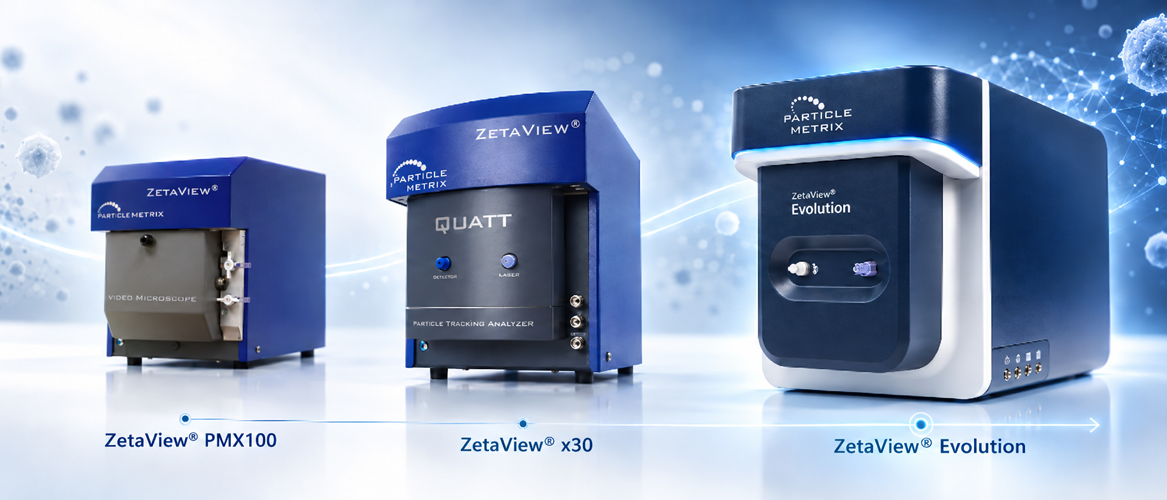
ZetaView has never been a static instrument. Since the launch of the first ZetaView in 2008, we have continuously developed the platform in response to new scientific questions, technological advances, and – most importantly – the needs of our users.
What started as an instrument for zeta potential measurement has evolved into a powerful multiparameter platform for nanoparticle characterization.
And with every new generation, our goal has remained the same: add new capabilities while protecting our customers' investment wherever possible.

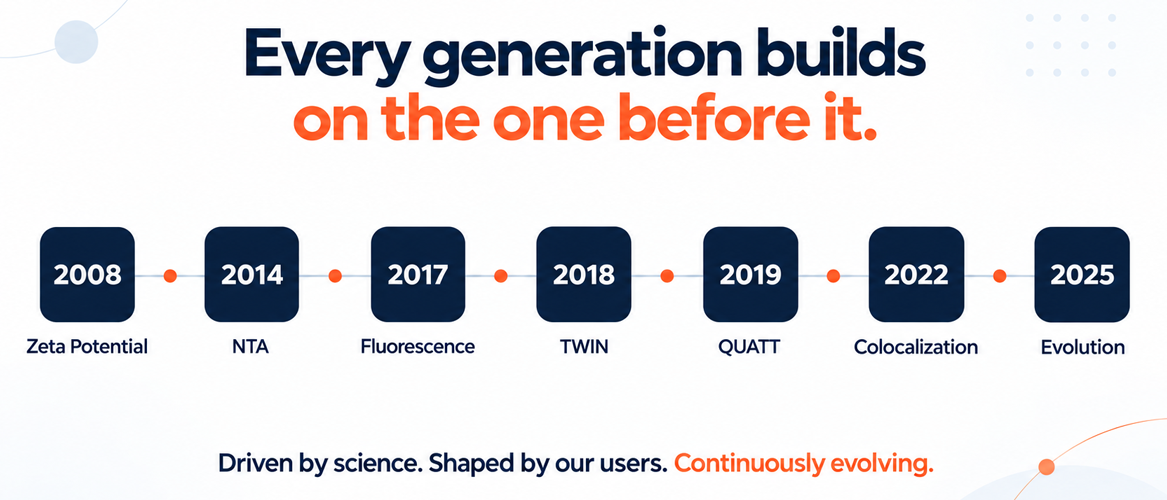
2008 – Where It All Started
The first instrument carrying the name ZetaView was launched in 2008.
The PMX100 was designed for to measure zeta potential, thereby establishing the technological foundation for what would later become the ZetaView® nanoparticle analysis platform.

2014 – ZetaView Becomes an NTA Platform
A major step followed in 2014 with the launch of the PMX110. For the first time, ZetaView provided true Nanoparticle Tracking Analysis (NTA), enabling users to determine both particle size and concentration.
This opened ZetaView to an entirely new scientific community. The instrument increasingly found its way into biological research – particularly into the rapidly growing field of extracellular vesicle (EV) research.
As this new community evolved, so did its requirements.
From Scatter to Fluorescence
EV researchers wanted to know more than simply how many particles were present and how large they were. They wanted to distinguish and characterize specific particle populations.
The answer was fluorescence NTA (F-NTA). Fluorescence detection was first implemented in the ZetaView 110 generation. With the launch of the ZetaView 120 in 2017, a significantly improved camera further enhanced fluorescence performance and established fluorescence analysis as an integral part of the ZetaView platform.
But a single fluorescence channel was only the beginning.

2018–2019 – More Lasers, More Possibilities
As fluorescence applications became more sophisticated, users asked for greater flexibility in fluorophore selection.
In 2018, Particle Metrix introduced the ZetaView TWIN with two excitation lasers. Only one year later, the ZetaView QUATT expanded the platform to four excitation lasers.
Users could switch between lasers with a single click in the software, making multiparameter fluorescence analysis straightforward without the need to manually change the sample or optical setup.
Importantly, these configurations were not designed as isolated instrument versions. Both the laser configuration and zeta potential functionality could be upgraded, allowing customers to expand the capabilities of their existing ZetaView as their research needs evolved.

2022 – Taking Fluorescence to the Next Level
The launch of the ZetaView® x30 series in 2022 marked another major advancement in fluorescence NTA. High-quality lasers combined with an optimized cell assembly further improved fluorescence performance and opened the door to fluorescence colocalization measurements, allowing researchers to investigate the simultaneous presence of different fluorescent markers on individual particles.
Once again, innovation did not mean leaving existing users behind. Upgrade options were developed to bring new capabilities of the x30 generation to existing x20 systems wherever technically possible.
2025 – A New Generation: ZetaView Evolution
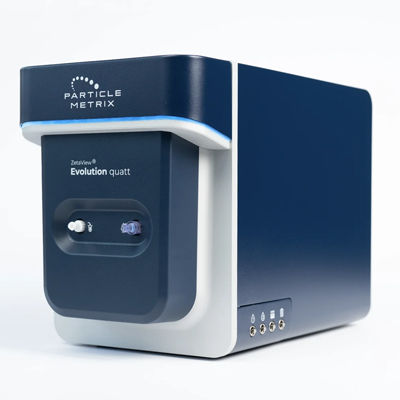
In 2025, ZetaView entered its next generation with the launch of ZetaView Evolution. The applications of NTA had continued to evolve – and so had the requirements of our customers. Alongside its established role in extracellular vesicle research, we saw a growing demand for nanoparticle characterization in the pharmaceutical and biopharmaceutical industries, including applications involving viral vectors and lipid nanoparticles (LNPs).
These emerging applications brought new expectations for measurement performance, robust quantification, reproducible workflows and ease of use – which helped shape the development of the next ZetaView generation.
Rethinking Concentration Measurement
One of the key innovations of ZetaView® Evolution is our new Concentration Scanning Technology.
Instead of estimating particle concentration from a limited number of observation volumes, Concentration Scanning captures and analyzes a substantially larger three-dimensional sample volume. This dramatically increases the number of particles included in the analysis bringing the statistical robustness of NTA-based concentration measurements to a new level.
At the same time, particle concentration is determined from a defined physical measurement volume, eliminating the need for concentration calibration. The result is calibration-free concentration measurement with significantly improved counting statistics, enabling robust and reliable nanoparticle quantification for increasingly demanding research and development applications.
Higher Sensitivity, Intuitive Control
ZetaView Evolution also introduces a new, highly sensitive camera, taking fluorescence NTA to the next level. Fluorescence signals corresponding to fewer than 20 Alexa Fluor™ 488 molecules can be detected, supporting the analysis of fluorescently labeled nanoparticles even at very low labeling levels.
The new ZetaSphere® software provides a modern and intuitive environment that brings instrument control, measurement, analysis and reporting together in one platform.
And the philosophy behind ZetaView remains unchanged: software and hardware upgrade options are available for x30 systems, enabling existing users to benefit from the key advances of the Evolution generation.
At the same time, the ZetaView x30 MONO remains available as a focused and cost-effective NTA solution for customers whose applications do not require the extended capabilities of the Evolution platform.
Innovation That Doesn't Leave You Behind
For us, innovation is not simply about launching a new instrument every few years. It is about listening to our users, understanding how nanoparticle research is evolving and continuously expanding what the ZetaView platform can do.
It is also about sustainability, flexibility, and protecting our customers’ long-term investment. Wherever technically possible, we develop upgrade paths that allow existing systems to benefit from new technologies rather than requiring complete instrument replacement.
By continuing to offer different system configurations, we also aim to provide the right solution for different applications, requirements, and budgets.
Shaped by Our Scientific Community
Understanding what researchers truly need requires close collaboration. Over the years, our collaboration partners have provided invaluable insights into emerging applications, scientific challenges and the changing requirements of nanoparticle research.
Their expertise, feedback and willingness to explore new approaches with us have helped us better understand our customers' needs and translate them into new ZetaView capabilities.
We are deeply grateful to the many researchers and collaboration partners who have contributed to the evolution of ZetaView.
From zeta potential in 2008 to NTA, fluorescence, multiple excitation lasers, colocalization and today's highly sensitive multiparameter ZetaView Evolution platform:

Ready for the Next Generation of Nanoparticle Analysis?
ZetaView has continuously evolved with the needs of researchers – from zeta potential measurement to advanced multiparameter NTA.
Discover how ZetaView Evolution brings the latest generation of particle size, concentration, fluorescence and zeta potential analysis into one powerful platform.