
Lipid Nanoparticles (LNPs) – Analysis with ZetaView®
Lipid Nanoparticles (LNPs) are highly innovative lipid-based structures that serve as transport vehicles for mRNAs for applications like vaccines or mRNA therapeutics. ZetaView® is ideally suited for the comprehensive characterization of these systems, by measuring size and concentration as well as zeta potential in scatter more or in fluorescence mode. These parameters are vital for the research and development of LNPs and equally fundamental for the rigorous monitoring of quality criteria in production.

Why are Lipid Nanoparticles important?
LNPs have revolutionized the delivery of genetic material, offering a scalable, biocompatible and highly efficient solution for intracellular transport. Their ability to encapsulate and protect fragile mRNA payloads — while targeting specific cell types — makes them essential for next-generation vaccines, cancer immunotherapies, and gene-editing technologies. Understanding the physical and surface properties of LNPs is critical to ensure stability, minimize off-target effects, and maximize therapeutic efficacy. ZetaView® empowers researchers to capture this essential data with precision, reproducibility and single-particle resolution.
ZetaView® Nanoparticle Tracking Analyzer
Your Advantages in the Analysis of Lipid Nanoparticles with ZetaView®
- Single-particle precision: Detection of particle size calibration free
- Concentration scans: Reproducible, highly accurate measurement of particle concentrations
- Target group analysis: fluorescence NTA (F-NTA) enables targeted analysis of labeled LNP subpopulations like His or kappa positive or cargo loaded fractions
- Zeta potential measurement: a parameter with direct affect on LNP stability, aggregation and cellular uptake
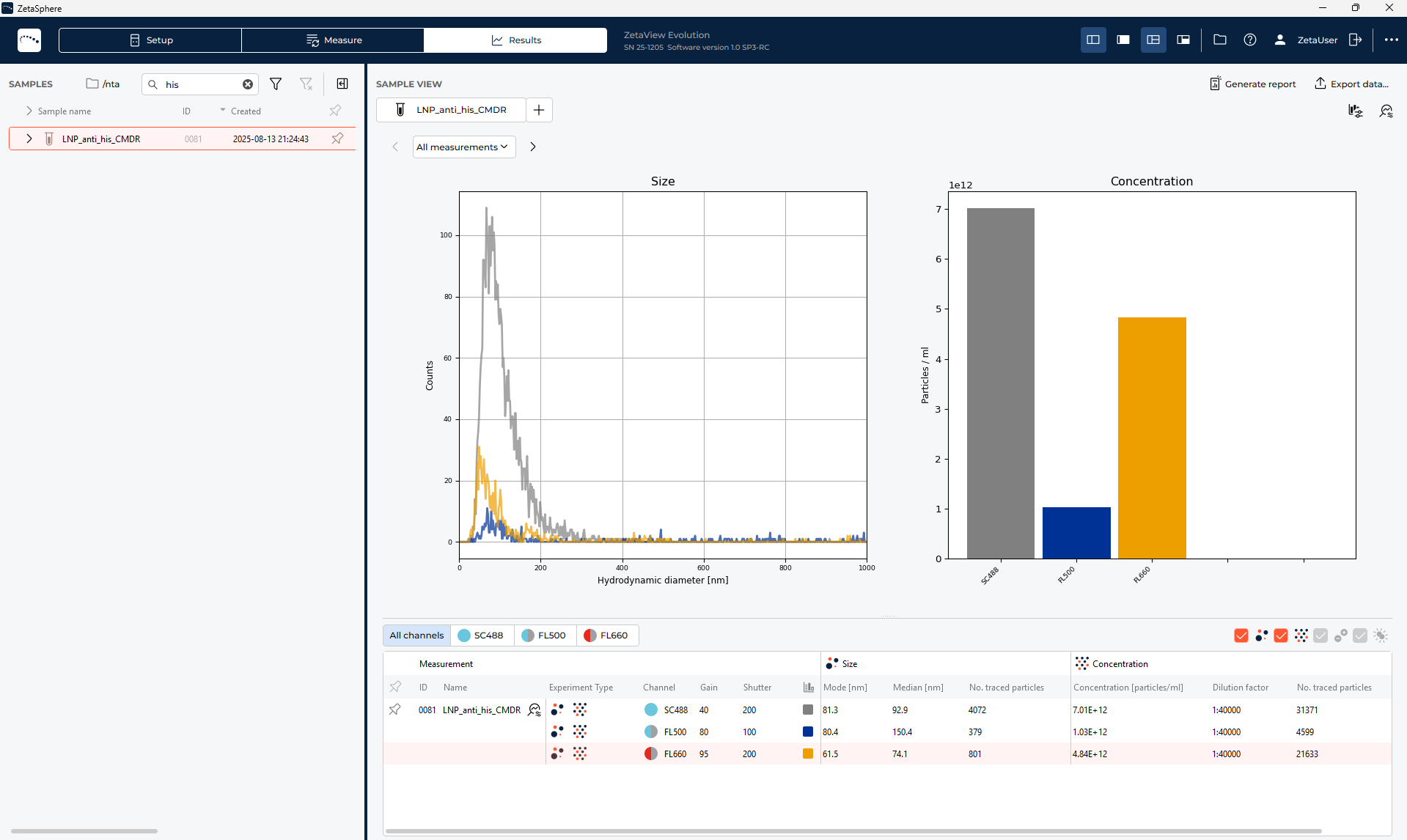
ZetaView® systems – equipped with up to four lasers and channels – enable a broad range of fluorescence data and combine size, concentration, zeta potential, and subpopulation analysis in a single measurement run.
The ZetaView® software interface shows single-particle fluorescence and scatter analysis of His-tagged lipid nanoparticles, highlighting subpopulation discrimination across three detection channels (SC488, FL500, FL660) with corresponding size distributions and concentration data.
Key Applications of Lipid Nanoparticles
- Optimization of LNP formulations for vaccine development and mRNA stability enhancement
- Characterization of cargo loading efficiency in functionalized or fluorescently labeled LNPs
- Process control under stress conditions such as temperature, agitation, or lyophilization
- Assessment of LNP surface modifications for improved targeting and cellular uptake
- Batch-to-batch consistency checks during pilot-scale and large-scale pharmaceutical manufacturing
- GMP-compliant quality control in biopharmaceutical production workflows

Our collaboration partner for LNPs
Steinbeis-Innovationszentrum Zellkulturtechnik (SIZ)
RNA therapeutics need efficient delivery, as naked mRNA is unstable. Lipid nanoparticles (LNPs) enable protection and transport.
With SIZ Mannheim, optimized LNPs are being developed. The ZetaView® system provides precise size and concentration analysis for characterization and quality control.






Looking to explore the potential of Lipid Nanoparticles in your field?
Get in touch for a demo or consultation – our experts will be pleased to support you with customized solutions for your LNP analysis.
Frequently asked questions about LNPs
What size are lipidnanoparticles?
Lipid nanoparticles typically range between 50 and 150 nm, depending on formulation and application. Size distribution plays a critical role in cellular uptake, biodistribution, and overall delivery efficiency in mRNA and gene therapy applications.
How are lipidnanoparticles measured?
Lipid nanoparticles are commonly analyzed using techniques such as nanoparticle tracking analysis (NTA), dynamic light scattering (DLS), and electron microscopy (TEM). NTA provides particle size distribution, concentration and zeta potential at the single-particle level, making it particularly useful for detailed characterization.
Why is particleconcentration important for LNPs?
Particle concentration is essential for dose control, reproducibility, and quality assurance. In therapeutic applications, accurate concentration measurements ensure consistent delivery of active compounds such as mRNA.
What is the advantageof NTA compared to DLS for LNP analysis?
NTA analyzes individual particles, allowing for high-resolution size distribution and direct concentration measurement. In contrast, DLS provides an intensity-weighted average, which can mask heterogeneity in polydisperse LNP samples.
Why is zeta potentialimportant for lipid nanoparticles?
Zeta potential reflects the surface charge of lipid nanoparticles and is a key indicator of
stability. It influences aggregation behavior, storage stability, and interactions with biological systems, including cellular uptake.
Whyare fluorescence measurements important for lipid nanoparticles (LNPs)?
Fluorescence measurements are widely used in LNP research and quality control because they enable sensitive and non-destructive analysis of critical nanoparticle properties. Fluorescent assays can be used to evaluate encapsulation efficiency, cargo release, particle stability, cellular uptake, and biodistribution. In mRNA and gene delivery applications, fluorescence-based methods help researchers optimize formulation performance, monitor manufacturing consistency, and better understand how LNPs interact with biological systems.